
 English
 русский
 Español
 عربى
عربى

Piston Air Compressor Fundamentals: Definition and Historical Development
The Essence of the Piston Air Compressor:
The reciprocating air compressor, or Piston Air Compressor, is the most fundamental and common type of mechanical equipment in the compressed air domain. It is essentially a Positive Displacement Compressor.
Definition: What is a Piston Air Compressor? (Defining its function, role, and core operation method—positive displacement compression). The Piston Air Compressor operates by an internal piston moving back and forth within a cylinder, continuously reducing the working volume, thereby increasing the pressure of the intake air, and finally delivering the high-pressure air to a receiver tank or system. Its core function is to convert mechanical energy into the pressure potential energy of a gas.
Unique Principle of Operation: Unlike dynamic compressors such as centrifugal or axial compressors, the Piston Air Compressor uses cyclical mechanical motion to force the reduction of gas volume. This operating method provides significant advantages in achieving high-pressure output and a wide pressure range.
Industrial Positioning: Due to its relatively simple structure, low maintenance costs, and ability to achieve high pressures, the Piston Air Compressor is widely used in applications requiring high pressures, and it performs exceptionally well under intermittent or varying load conditions.
Historical Footprints: The Evolution of the Piston Air Compressor
The concept behind the Piston Air Compressor can be traced back to ancient bellows, but the modern reciprocating compressor matured with the Industrial Revolution.
Early Stages: Initial compressors were primarily used for blowing air and driving early pneumatic machinery, often powered by water or steam engines. They were crude, inefficient, and slow. Electrification and Standardization: With the widespread adoption of electric motors, the Piston Air Compressor gained a reliable and efficient power source, enabling miniaturization and widespread use in workshops. Concurrently, advancements in mechanical design and materials science introduced more durable piston rings and more precise valve systems, significantly improving efficiency and reliability.
Key Technological Milestones: Introduction of Multi-Stage Compression: To achieve higher operating pressures and manage the immense heat generated during the compression process, the multi-stage Piston Air Compressor was invented. It improves efficiency and protects equipment by cooling the gas between stages (intercooling).
Innovation in Lubrication Technology: In response to varied industry requirements for air quality, the Oil-Free Piston Air Compressor was developed. It uses special piston ring materials or coatings to eliminate the risk of oil contamination, meeting the strict standards of industries like food processing and pharmaceuticals.
An Overview of Piston Air Compressor Classification:
Based on structural features and usage requirements, the Piston Air Compressor can be categorized into various types. Understanding these classifications is crucial for selecting the appropriate equipment.
Classification by Number of Stages:
| Feature | Single-Stage Piston Air Compressor | Multi-Stage Piston Air Compressor |
| Compression Principle | Compression is completed in one step, raising the pressure from ambient to the target pressure directly. | Compression is completed in two or more steps, with cooling between each cylinder (stage). |
| Maximum Pressure | Lower, typically below 135 PSI (≈ 9.3 bar). | Higher, often reaching 175 PSI and above (e.g., 3000 PSI for high-pressure units). |
| Efficiency/Energy Use | Acceptable efficiency for low-pressure applications, but high energy consumption and discharge temperature at high pressure. | Higher energy efficiency due to intercooling, which approximates isothermal compression. |
| Discharge Temperature | Higher, as all heat is generated in a single compression stroke. | Lower, as heat is dissipated and removed, making the equipment and piping safer. |
| Application Range | Small workshops, household DIY, driving small pneumatic tools. | Industrial production lines, heavy-duty automotive repair, applications requiring continuous high pressure. |
Classification by Lubrication Method:
| Feature | Oil-Lubricated Piston Air Compressor | Oil-Free Piston Air Compressor |
| Lubrication Method | Lubricating oil is present in the crankcase to lubricate the connecting rods, bearings, and cylinder walls (partially splash-lubricated). | No lubricating oil contacts the piston and cylinder. Self-lubricating materials like Teflon are typically used. |
| Air Quality | Compressed air contains oil vapor, requiring oil-water separators and filters for removal. | Compressed air is clean and oil-free, representing the highest-grade air source. |
| Durability | Long lifespan and less wear due to oil film protection, suitable for continuous or heavy-duty operation. | Parts wear relatively faster, but are easier to maintain. |
| Maintenance Requirements | Requires periodic checking and changing of compressor oil. | Generally maintenance-free regarding oil changes, but piston rings need inspection and replacement. |
| Application Range | Most industrial pneumatic tools, tire inflation, general mechanical processing. | Food and beverage, pharmaceutical, medical (e.g., dental), precision electronics, and breathing air supply. |
Classification by Drive Method:
| Type | Drive Source | Suitability |
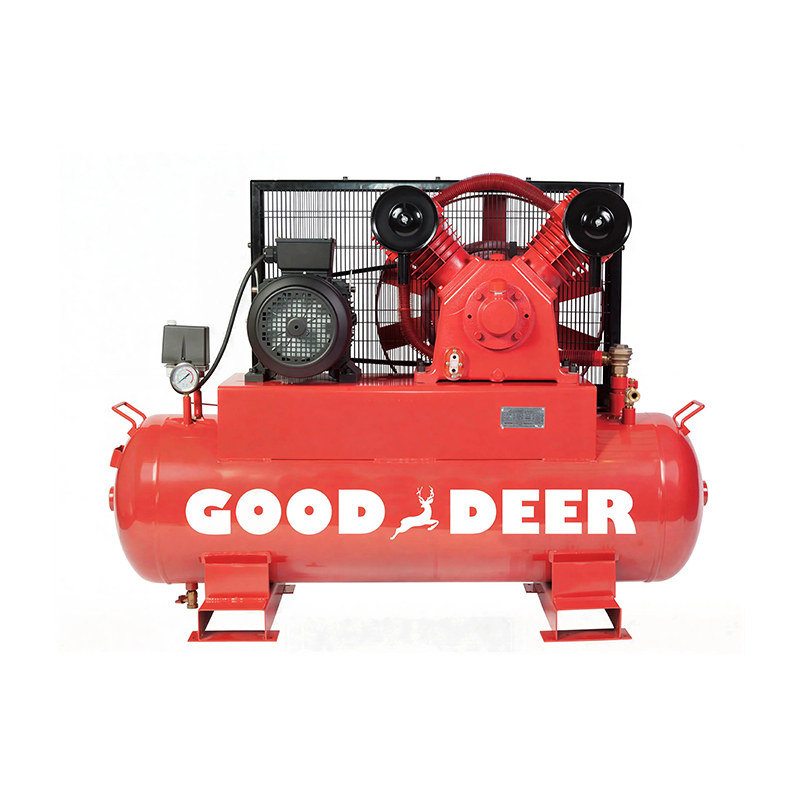
| Electric | AC or DC electric motor | Most common, suitable for indoor workshops, factories, and places with a stable power supply. |
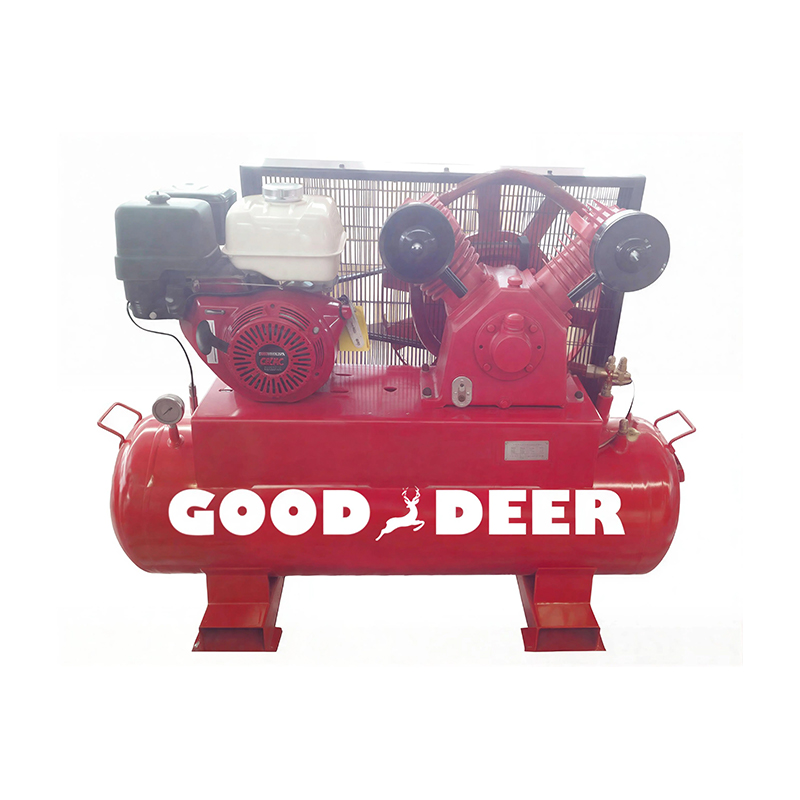
| Engine-Driven | Gasoline or diesel engine | Suitable for outdoor construction, remote areas, or mobile operations where power supply is insufficient. |
Piston Air Compressor Core: Working Principle and Mechanical Structure
The Basic Working Cycle of the Piston Air Compressor:
The compression process of the Piston Air Compressor follows a simple four-stroke cycle (corresponding to two reciprocating movements of the piston). This cycle uses the piston's motion to alternately open and close the valves, thereby achieving the intake, compression, and discharge of air.
First Stroke: Intake The driver (motor or engine) rotates the crankshaft, which moves the piston downwards (away from the cylinder head) via the connecting rod. The cylinder volume increases, the pressure drops rapidly below ambient atmospheric pressure, creating a partial vacuum. The pressure differential forces the intake valve (suction valve) to open automatically, and external air is drawn into the cylinder through the inlet port and filter.
Second Stroke: Compression After reaching the Bottom Dead Center (BDC), the piston starts moving upwards. The intake valve closes automatically as the pressure inside the cylinder rises, sealing the air inside the cylinder. The piston continuously pushes the air upwards, the cylinder volume gradually shrinks, and the air's pressure and temperature sharply increase.
Third Stroke: Discharge When the air pressure inside the cylinder reaches or slightly exceeds the preset pressure of the receiver tank or discharge line, the discharge valve (exhaust valve) is pushed open by the high-pressure air. The piston continues moving upwards, pushing the high-pressure compressed air out of the cylinder through the discharge valve and piping, sending it to the next stage cooler or the receiver tank.
Fourth Stroke: Expansion & Repeat After the piston reaches the Top Dead Center (TDC), it begins to move downwards again. The discharge valve closes, and the small amount of high-pressure air remaining in the cylinder (known as "clearance volume" air) starts to expand. When the residual air pressure drops below atmospheric pressure, the intake valve opens again, starting a new intake stroke.
In-Depth Analysis of Piston Air Compressor Core Components:
The reliability of the Piston Air Compressor depends on the precise coordination and durability of its main mechanical components.
Cylinder and Piston:
- Cylinder: The working space where compression occurs, typically made of cast iron or aluminum alloy, requiring high strength and good heat dissipation.
- Piston: The reciprocating component that, through the piston rings, forms a tight seal with the cylinder wall, preventing gas leakage during compression.
- Piston Rings: Divided into compression rings (for sealing) and oil rings (for scraping oil and controlling lubrication). In oil-free Piston Air Compressor models, compression rings are often made of self-lubricating materials (such as PTFE composites) to ensure Oil-Free operation.
Crankshaft and Connecting Rod:
- Crankshaft: Converts the rotational motion of the drive source (motor) into the reciprocating motion of the connecting rod end.
- Connecting Rod: Links the piston to the crankshaft and is a crucial structure for transmitting driving force.
- Function: They collectively form the power transmission core of the Piston Air Compressor.
Valve System:
- The valve is the "heart" of the Piston Air Compressor operation, automatically opening or closing based on the pressure difference inside and outside the cylinder to control the gas flow direction.
- Types: The most common are Reed Valves or Plate Valves. They operate passively, relying entirely on pressure changes during compression without external mechanical drive, making them simple and responsive.
- Valve Efficiency: The sealing capability and flow resistance of the valve directly affect the compressor's volumetric efficiency.
Receiver Tank:
Functions:
- Store Compressed Air: Satisfies instantaneous high demand, preventing frequent starting and stopping of the compressor.
- Stabilize Pressure: Balances the pulsations caused by piston discharge, smoothing the output airflow.
- Preliminary Cooling and Dehydration: The compressed air cools down upon entering the receiver tank, causing water vapor to condense into liquid water that settles at the bottom. Cooling System: Importance: According to thermodynamics, the compression process releases a significant amount of heat. If heat is not dissipated promptly, it will not only reduce efficiency but also damage the valves and seals.
Common Forms:
- Air-Cooled Piston Air Compressor: Heat is dissipated directly into the ambient air using cooling fins on the cylinder and pipes, driven by a fan. Suitable for most small and medium-sized units.
- Water-Cooled Piston Air Compressor: Water jackets are set up around the cylinder and/or intercooler, and circulating water removes the heat. Suitable for large, continuously operating, high-pressure equipment.
Differences Between Single-Stage and Multi-Stage Piston Air Compressor:
Both types rely on piston reciprocation, but their cylinder arrangement and operation differ fundamentally, determining their applicable pressure range and energy efficiency. Detailed Comparison Table:
| Feature | Single-Stage Piston Air Compressor | Multi-Stage Piston Air Compressor |
| Operating Principle | Compression is completed in one cylinder, reaching the final pressure in a single step. | Compression is completed in two or more stages (cylinders) sequentially. |
| Heat Management | No intercooling. Compression heat is concentrated in the final discharge gas, leading to high discharge temperatures. | Equipped with an Intercooler, used to cool the gas discharged from the previous stage, lowering the intake temperature for the next stage. |
| Energy Efficiency | Lower efficiency than multi-stage, especially in high-pressure applications. | Re-compression after cooling approximates the ideal isothermal process, resulting in higher energy efficiency. |
| Cylinder Size | Usually one or more cylinders of the same size. | Cylinder sizes are often different: the first stage (low-pressure) cylinder is the largest to intake a large volume of air; subsequent stages have progressively smaller cylinders to handle the already reduced volume of air. |
| Typical Application Pressure | Medium-to-low pressure applications at 7 bar (≈ 100 PSI) and below. | High-pressure and continuous operation applications at 12 bar (≈ 175 PSI) and above. |
The main advantage of the multi-stage Piston Air Compressor lies in intercooling. According to gas laws, reducing the gas temperature during compression reduces its volume, thereby reducing the work required for the next compression stage. This is the secret to its high efficiency and allows for high-pressure output while protecting internal components from excessive heat damage.
Piston Air Compressor Performance Parameters and Efficiency Considerations
Interpretation of Key Performance Indicators:
The following three metrics are core to evaluating any Piston Air Compressor.
Free Air Delivery (FAD):
- Definition: FAD is the actual volume of free air discharged by the compressor per unit of time under standard intake conditions (standard temperature, pressure, and relative humidity). It is the most important capacity indicator for a compressor.
- Units: Typically expressed in CFM (Cubic Feet per Minute) or m³/min (Cubic Meters per Minute).
- Importance: It determines how many pneumatic tools the Piston Air Compressor can drive simultaneously or how large the system's air demand can be met. In practical applications, the FAD should be selected based on the accumulated CFM requirement of all pneumatic tools, with a margin of 20% to 30% added.
Operating Pressure:
- Definition: The maximum pressure the compressor can consistently provide and the pressure used for daily work.
- Units: Typically expressed in PSI (Pounds per Square Inch) or bar (Bar).
- Importance: Must meet the minimum operating pressure required by the pneumatic tools or the final application. As mentioned, the single-stage Piston Air Compressor is suitable for medium-to-low pressure, while multi-stage units can provide much higher pressures.
- Note: The maximum working pressure indicated on the receiver tank is usually slightly higher than the daily operating pressure to account for system fluctuations.
Power (Horsepower/kW):
- Definition: The rated output power of the electric motor or internal combustion engine required to drive the Piston Air Compressor.
- Units: Horsepower (HP) or Kilowatts (kW).
- Importance: Power is not linearly correlated with FAD. An efficiently designed Piston Air Compressor can provide higher FAD at lower power, which directly relates to energy efficiency.
Thermodynamic Basis and Piston Air Compressor Efficiency:
The efficiency of reciprocating compression requires the introduction of thermodynamic concepts, as the compression process is fundamentally one of energy conversion and heat release.
Ideal Compression Processes:
- Isothermal Compression: The theoretical ideal compression process. Gas temperature remains constant during compression (all generated heat is instantly removed). This path achieves the minimum power consumption.
- Adiabatic Compression: No heat exchange occurs between the gas and the surroundings during compression. This leads to a sharp increase in gas temperature and pressure, resulting in maximum power consumption.
Actual Piston Air Compressor Process:
- The actual Piston Air Compressor process lies between isothermal and adiabatic (known as polytropic compression).
- Heat: The significant heat generated during compression is a major source of power loss. The intercooling adopted by the multi-stage Piston Air Compressor is precisely intended to bring the compression process closer to the ideal isothermal compression, thus improving efficiency.
Volumetric Efficiency:
Influencing Factors:
- Clearance Volume: The remaining space between the cylinder head and the piston crown when the piston is at the Top Dead Center. The high-pressure gas trapped in this volume expands at the start of the intake stroke, reducing the actual amount of fresh air sucked in. The smaller the clearance volume, the higher the volumetric efficiency.
- Valve Resistance: The pressure difference required to open and close the valves and the flow resistance when passing through the valves.
- Leakage: Poor sealing at the piston rings, valves, or joints.
- Heating: Intake air is preheated by the cylinder walls after entering the cylinder, leading to volume expansion and a reduction in actual mass.
Specific Power of the Compressor:
- Definition: The most direct indicator for measuring the energy efficiency of the compressor. It represents the electrical energy or power consumed by the compressor to produce a unit of Free Air Delivery (FAD).
- Calculation: Specific Power = Input Power (kW) / Free Air Delivery (m³/min or CFM)
- Importance: A lower specific power indicates a more energy-efficient Piston Air Compressor. In the evaluation of long-term operating costs, this is a more critical parameter than the initial purchase price.
Performance Parameter Summary: The Trade-off Between FAD and Power
When selecting a Piston Air Compressor, a trade-off between FAD and HP/kW is required.
| Evaluation Parameter | Influencing Factor/Indicator | Ideal State (High Efficiency) | Low-Efficiency Piston Air Compressor |
| FAD | Volumetric efficiency, piston size, speed | Provides a higher FAD for a given HP. | Provides a lower FAD for a given HP. |
| Operating Pressure | Number of compression stages, cylinder strength | Capabler of stable operation at 12 bar and above (multi-stage unit). | Output pressure above 9 bar is challenging (single-stage unit). |
| Specific Power | Cooling effect, clearance volume | Low numerical value (indicates low energy consumption per unit of air). | High numerical value (indicates high energy consumption). |
| Operating Temperature | Cooling system efficiency | Low final discharge temperature and casing temperature. | High temperature, prone to internal parts wear and oil degradation. |
By comprehensively analyzing these indicators, users can accurately assess whether a Piston Air Compressor can meet their specific air source needs economically and efficiently. In the long run, equipment with low specific power, despite a potentially higher initial investment, can significantly reduce electricity costs.
Piston Air Compressor Wide-Ranging Application Scenarios
Industrial Manufacturing Sector:
In industrial production environments, compressed air is often called the "fourth utility," and the Piston Air Compressor is one of the main forces providing this power.
-
Driving Pneumatic Tools:
-
Application: The reciprocating compressor is the ideal air source for various pneumatic tools such as impact wrenches, air drills, air hammers, grinders, and riveting tools. These tools are favored for their high power density, lightweight nature, durability, and explosion-proof characteristics (not requiring electric drive).
-
Demand Characteristics: Reciprocating compressors handle the intermittent, high-flow pulse demand of pneumatic tools well.
-
-
Painting and Surface Treatment:
-
Application: In stages like automobile manufacturing, furniture production, and metal structure corrosion protection, the Piston Air Compressor provides stable pressure to drive spray guns, sandblasting equipment, or shot-blasting cleaners.
-
Key Requirement: For fine painting, the demand for oil-free Piston Air Compressor is high to ensure the compressed air contains no oil contamination, preventing surface defects.
-
-
Pneumatic Control Systems and Automation:
-
Application: Used to drive pneumatic actuators, cylinders, and valves to achieve clamping, positioning, conveying, sorting, and other automation operations on production lines.
-
Advantage: Compressed air provided by the Piston Air Compressor is a clean, rapidly responding power medium in many industrial-grade control systems.
-
-
Other Industrial Uses: Plastic blow molding, stamping machinery, high-pressure gas transfer, etc.
Automotive Service and Repair:
The automotive repair and body paint industry is a traditional and major market for the Piston Air Compressor.
-
Tire Service and Inflation:
-
Application: From inflating passenger car tires to pressurizing heavy-duty truck tires, a stable and reliable Piston Air Compressor is required.
-
-
Auto Painting and Body Repair:
-
Application: Driving sanders, polishers, and professional spray guns. The multi-stage Piston Air Compressor can provide higher working pressure and stable airflow, meeting the demands of large paint booths.
-
-
Pneumatic Lifts and Jacks:
-
Application: In repair workshops, some high-tonnage lifting equipment and jacks require high-pressure air for operation.
-
Home, Small Workshops, and Construction Industry:
Portable and small Piston Air Compressor units are extremely common in personal and construction site applications.
-
Home Improvement and Woodworking:
-
Application: Driving pneumatic nail guns, staplers, etc., for floor installation, furniture making, and roofing work. These applications typically use compact, easily transportable single-stage Piston Air Compressor units.
-
-
Airbrushing and Model Making:
-
Application: Airbrush artists and model makers require small Piston Air Compressor units that provide continuous, low-pulsation, and low-noise air, usually the oil-free silent type.
-
-
Construction Sites:
-
Application: Engine-driven Piston Air Compressor units are used to power concrete vibrators, rock drills, or high-pressure spraying equipment, solving the problem of operating outdoors without electricity.
-
Specific and High-Purity Environmental Applications:
Industries with stringent requirements for air cleanliness often rely on the oil-free Piston Air Compressor to provide critical air sources.
-
Medical and Dental:
-
Application: Dental drills, hospital ventilators, laboratory pneumatic equipment, etc., have zero tolerance for air purity. Oil-free Piston Air Compressor units ensure the air is free of any lubricating oil particles, preventing contamination of patients and sensitive equipment.
-
Specialty: Medical Piston Air Compressor units usually come with additional filtration, drying, and sterilization systems.
-
-
Food and Beverage and Pharmaceutical:
-
Application: In food packaging, beverage filling, aeration in fermentation processes, and drug manufacturing/packaging, the compressed air must meet high-purity standards to avoid cross-contamination of products with any oil.
-
-
Electronics and Precision Manufacturing:
-
Application: Used for cleaning sensitive electronic components and driving precision automated machinery, requiring extremely high air cleanliness and dryness.
-
Comparison of Piston Air Compressor Type Requirements by Application Scenario:
Different application scenarios have varied requirements for the Piston Air Compressor in terms of operating pressure, air quality, and duty cycle.
| Application Scenario | Typical Pressure Requirement (PSI) | Flow Requirement (CFM) | Recommended Piston Air Compressor Type | Key Requirements |
| Large Industrial Painting | 90 ~ 150 | High (≥ 30) | Multi-stage oil-lubricated, equipped with powerful dryer | Stable airflow, high dryness, continuous operation capability. |
| Household Nail Gun | 90 ~ 120 | Low (≤ 5) | Small single-stage portable | Lightweight, easy to move, intermittent use. |
| Heavy-Duty Pneumatic Tools (Wrenches) | 120 ~ 175 | Medium-High (15 ~ 30) | Multi-stage oil-lubricated or high-HP single-stage unit | Fast pressure recovery, high durability. |
| Dental/Medical | 60 ~ 100 | Low-Medium (5 ~ 15) | Oil-free silent Piston Air Compressor | 100% oil-free air, low noise, high reliability. |
| Construction Site Outdoor Work | 100 ~ 150 | High (≥ 50) | Engine-driven type | High mobility, capable of operating without electricity. |
Piston Air Compressor Selection Guide and Installation Essentials
How to Select the Right Piston Air Compressor:
Selecting a reciprocating air compressor is a demand-driven process. It is essential to first thoroughly analyze the specific requirements of the pneumatic tools and system.
-
Step 1: Demand Flow Analysis (Determine FAD)
-
Cumulative Calculation: List all pneumatic tools or equipment to be driven by the Piston Air Compressor and find their requirements at the required operating pressure (usually provided in the tool manual).
-
Diversity Factor: In practice, it is unlikely that all tools will run simultaneously at full load. An estimate for the maximum instantaneous demand should be made based on experience (typically to ).
-
Allowance Margin: To account for future demand growth, piping leaks, and efficiency drop due to the aging of the Piston Air Compressor, the final selected compressor should be at least to higher than the calculated maximum demand.
-
Simplified Formula:
-
-
Step 2: Determine Operating Pressure
-
Highest Pressure Requirement: Determine the highest pressure required by all tools. The maximum output pressure (cut-out pressure) of the Piston Air Compressor must be higher than this value.
-
Pressure Loss: Pressure loss will occur in the piping and filters from the compressor to the final point of use. This factor must be considered in the design.
-
Stage Selection: If the required operating pressure consistently exceeds (), a Multi-Stage Piston Air Compressor should be selected to ensure efficiency and component longevity.
-
-
Step 3: Consider the Duty Cycle
-
Reciprocating Compressor Limitations: Most oil-lubricated Piston Air Compressor units are designed for intermittent operation. Their designed duty cycle is typically to (the ratio of running time to rest time per hour).
-
Continuous Demand: If the application requires continuous operation (e.g., a large automation production line), then a Multi-Stage Piston Air Compressor designed for continuous duty or another type of compressor should be selected. If a reciprocating unit is forced to run continuously beyond its duty cycle, it will lead to overheating, inadequate lubrication, and rapid damage to piston rings and valves.
-
-
Step 4: Determine Air Quality Requirements (Oil-Lubricated vs. Oil-Free)
-
Based on the application environment (refer to Section IV), decide whether an Oil-Free Piston Air Compressor is needed to avoid oil contamination. If an oil-lubricated unit is used, additional investment must be budgeted for efficient oil separation filters and air dryers.
-
Key Parameter Selection Comparison:
| Selection Consideration | Single-Stage Piston Air Compressor | Multi-Stage Piston Air Compressor |
| Primary Use | Intermittent, mobile operation, low flow demand | Continuous/heavy-duty operation, high flow, high pressure demand |
| Efficiency | Acceptable at low pressure, poor efficiency at high pressure | High overall energy efficiency, more energy-saving especially at high pressure |
| Heat Dissipation | Relies on simple air cooling, prone to overheating | Has intercooling, runs at a lower temperature |
| Initial Cost | Lower | Higher |
| Running Cost | High energy consumption, long-term cost may be higher | Low energy consumption, lower long-term cost |
Installation and Layout Considerations:
The installation location and environmental layout of the Piston Air Compressor directly affect its performance, maintenance convenience, and safety.
-
Foundation and Vibration Isolation:
-
Foundation Requirements: The compressor, especially large Piston Air Compressor units, should be installed on a flat, solid concrete floor.
-
Vibration Isolation: The reciprocating motion of the piston generates noticeable vibration and noise. Vibration pads or isolators should be used to protect the compressor itself and reduce noise impact on the working environment.
-
-
Ventilation and Ambient Temperature:
-
Critical Factor: For every () increase in the temperature of the air sucked in by the compressor, its power consumption increases by approximately .
-
Ventilation Requirements: The installation area must have an adequate supply of fresh air and a good ventilation system to remove the heat generated during compressor operation. The air intake should be kept away from heat sources (like boilers, ovens) and pollution sources (like exhaust gas, chemical fumes).
-
Minimum Space: Sufficient space should be left around the compressor for routine maintenance and heat dissipation.
-
-
Piping System Design:
-
Pressure Loss: Improper design of the piping system is the main cause of system pressure loss. Appropriately large pipe diameters should be used to minimize the frictional resistance to airflow.
-
Materials: Compressed air pipes should be made of pressure-resistant and corrosion-resistant materials, such as galvanized steel, copper, or specialized aluminum/plastic piping.
-
Slope and Drainage: Compressed air piping should be slightly sloped to facilitate the flow of condensate to specific drainage points or filters, preventing it from accumulating in the pipes.
-
-
Condensate Management:
-
A large amount of water vapor condenses after the high heat of compression is cooled. Automatic or manual drain valves must be installed at the bottom of the receiver tank, the cooler outlet, and low points in the piping.
-
Environmental Requirement: Discharged oil-water separated condensate is considered a pollutant and cannot be directly released. It requires pre-treatment using a specialized oil-water separator.
-
Proper planning of the Piston Air Compressor selection and installation is a prerequisite for ensuring its safe and efficient operation, ultimately guaranteeing the stability of the entire pneumatic system.
Piston Air Compressor Routine Maintenance and Troubleshooting
The Piston Air Compressor is a high-load reciprocating machine, and its performance and lifespan largely depend on strict and regular preventive maintenance. Neglecting maintenance will lead to a sharp decline in efficiency, high repair costs, and even downtime.
Preventive Maintenance Strategies:
Establishing a structured maintenance schedule is fundamental to ensuring the stable operation of the Piston Air Compressor.
-
Lubrication System Maintenance (for Oil-Lubricated Piston Air Compressor):
-
Oil Change Interval: Follow the manufacturer's recommended operating hours for replacement (e.g., every to hours). The interval should be shortened in dusty or high-temperature environments.
-
Oil Level Check: Check the oil level daily or before each startup, ensuring it is between the minimum and maximum limits indicated on the dipstick. Too little oil leads to insufficient lubrication, while too much may cause oil carry-over into the compressed air.
-
Oil Selection: Compressor oil specifically designed for the Piston Air Compressor must be used. Automotive engine oil is not suitable for reciprocating compressors due to different operating temperature and pressure requirements. Specialized oil offers better anti-oxidation, anti-emulsification, and high flash points.
-
-
Air Filter Inspection and Replacement:
-
Function: The intake filter is the first line of defense protecting the Piston Air Compressor cylinder, piston rings, and valves. It prevents dust, particles, and contaminants from entering the cylinder and causing wear.
-
Inspection and Cleaning: Regularly check the filter element for clogging or contamination. Mild contamination can be cleaned, but severe clogging necessitates replacement. A clogged filter reduces volumetric efficiency (FAD), increases energy consumption, and can cause a vacuum inside the cylinder, hindering the compressor's normal intake.
-
-
Valve System Inspection:
-
Inspection Frequency: The valves are high-frequency, high-stress components and should be inspected regularly or immediately upon noticing performance degradation.
-
Content: Check valve plates and seats for cracks, wear, or carbon buildup. Valve leakage is one of the most common causes of low pressure and overheating in the Piston Air Compressor. Leaking valves must be replaced promptly.
-
-
Drive System Inspection and Tensioning (for Belt-Driven Piston Air Compressor):
-
Belt Condition: Regularly inspect the belt for signs of wear, cracking, or aging.
-
Belt Tension: Check and adjust the belt tension. A belt that is too loose will slip, wasting drive power and generating heat; a belt that is too tight will increase bearing load, shortening bearing life.
-
Receiver Tank and Safety System Maintenance:
-
Regular Draining of Condensate:
-
Importance: Most of the water vapor generated during compression will condense in the receiver tank. This condensate must be drained daily or even per shift. Excessive water buildup reduces the tank's storage capacity and, more importantly, corrodes the tank walls, posing a safety hazard.
-
Operation: Use the drain valve at the bottom of the receiver tank.
-
-
Safety Valve Testing:
-
Function: The safety valve is the last line of defense preventing the Piston Air Compressor receiver tank from over-pressurization and rupture.
-
Testing: The safety valve's functionality should be tested periodically (e.g., annually) to ensure it opens and releases pressure at the preset maximum working pressure. A damaged or tampered safety valve is extremely dangerous.
-
Piston Air Compressor Common Failures and Troubleshooting:
Identifying signs of failure and taking correct troubleshooting measures can minimize downtime.
| Failure Symptom | Possible Cause | Troubleshooting Approach |
| Low Pressure/Slow Pressurization | 1. Valve leakage (most common). 2. Excessive piston ring wear or damage. 3. Severely clogged intake filter. 4. Loose or slipping belt (belt-driven units). |
1. Inspect valves and replace damaged plates. 2. Replace piston rings to restore cylinder sealing. 3. Clean or replace the air filter. 4. Check and adjust belt tension. |
| Excessive Operating Noise | 1. Loose internal mechanical components (connecting rod, crankshaft). 2. Valve failure. 3. Worn bearings. 4. Failed vibration pads or unstable mounting foundation. |
1. Immediately shut down, inspect, and tighten internal bolts and connecting rod nuts. 2. Replace damaged bearings or valves. 3. Inspect and replace vibration pads. |
| Excessive Discharge Temperature | 1. Low cooling system efficiency (fan failure/dirty fins). 2. Poor ventilation in the operating environment. 3. Valve leakage causing hot gas backflow. 4. Excessive duty cycle beyond the compressor's design load. |
1. Clean cooling fins, check the fan or water cooling system. 2. Improve ventilation at the installation site. 3. Replace leaking valves. 4. Shorten the running cycle to allow the unit to cool. |
| Frequent Water Drainage/High Oil Content | 1. Oil-lubricated unit oil level is too high. 2. Oil carry-over due to cylinder and piston ring wear. 3. Low efficiency of oil-water separator or failure to drain. |
1. Adjust the oil level to the normal range. 2. Replace piston rings and oil rings. 3. Regularly drain the receiver tank and oil-water separator. |
| Compressor Cycles On/Off Frequently | 1. Severe leakage in the receiver tank or piping. 2. Pressure switch set with too narrow a pressure differential. 3. Insufficient receiver tank drainage, reducing actual capacity. |
1. Use soapy water to check and repair leaks at pipe joints and valves. 2. Adjust the cut-in/cut-out pressure differential of the pressure switch. 3. Drain condensate from the receiver tank. |
Through systematic maintenance and troubleshooting, the lifespan of the Piston Air Compressor can be maximized, ensuring it operates at its optimal energy efficiency point. Maintaining a maintenance log is crucial for tracking equipment health and planning long-term spare parts procurement.
In-Depth Q&A: FAQ about Piston Air Compressor
Q1: How do I tell if my Piston Air Compressor is single-stage or multi-stage?
A: The determination of the stage count in a reciprocating air compressor primarily relies on the following observations:
| Observation Feature | Single-Stage Piston Air Compressor | Multi-Stage Piston Air Compressor |
| Cylinder Appearance | Usually only one set of cylinders, which are identical or similar in size. | At least two cylinders of noticeably different sizes. The first stage (low-pressure stage) cylinder is the largest, and the subsequent stage (high-pressure stage) cylinder is smaller. |
| Operating Pressure | Maximum pressure typically does not exceed 135 PSI (≈ 9.3 bar). | Maximum pressure is usually 175 PSI (≈ 12 bar) or higher. |
| Cooling System | Only final discharge cooling (air cooling fins). | Equipped with an Intercooler between the cylinders, typically a finned tube connecting the two cylinders. |
Q2: Which is more suitable for me: Oil-lubricated or Oil-free Piston Air Compressor?
A: The choice depends on the requirements for air quality, maintenance, and lifespan. There is no absolute "better" one, only one "more suitable" for a given application.
| Feature Comparison | Oil-Lubricated Piston Air Compressor | Oil-Free Piston Air Compressor |
| Air Cleanliness | Compressed air contains oil mist, requiring extra filtration. | 100% oil-free, high air cleanliness. |
| Energy Consumption | Higher efficiency (piston and cylinder are well-lubricated), lower specific power. | Higher friction, slightly lower efficiency, slightly higher specific power. |
| Lifespan and Durability | Longer lifespan, more wear-resistant, suitable for heavy-duty/long-duration operation. | Relatively shorter lifespan, not suitable for long-duration continuous operation. |
| Maintenance | Requires periodic checking/changing of compressor oil and oil filters. | Generally maintenance-free (no oil changes), but self-lubricating piston rings need checking. |
| Applications | Automotive repair, general industry, general pneumatic tools. | Medical, dental, food processing, pharmaceutical, high-precision electronics. |
Q3: Why does my Piston Air Compressor produce a lot of condensate?
A: This is a normal but necessary-to-manage physical phenomenon. Air always contains water vapor. When air is compressed by the Piston Air Compressor, its volume shrinks, and its temperature rises. Subsequently, when the high-pressure air cools down in the receiver tank or piping:
-
Water Vapor Partial Pressure Increases: After compression, the saturated vapor pressure of water vapor increases with the rise in pressure.
-
Temperature Drops: The air temperature in the receiver tank or piping drops below the dew point.
-
Condensation: Water vapor with a relative humidity exceeding condenses into liquid water (condensate).
The amount of condensate produced is directly proportional to the ambient humidity, air temperature, and the compressor's . This water must be drained daily from the bottom of the receiver tank; otherwise, it will cause internal rust of the tank and travel with the compressed air into pneumatic tools and piping, leading to tool damage and product contamination.
Q4: How can I resolve the noise issue of my Piston Air Compressor?
A: The noise generated by the Piston Air Compressor primarily comes from air intake, discharge pulsations, mechanical vibration from piston reciprocation, and the cooling fan. The following measures can be taken:
-
Sound Insulation: Install the compressor in a dedicated compressor room or an acoustic enclosure.
-
Vibration Isolation: Ensure the compressor is securely mounted on vibration pads or isolators to reduce mechanical vibration transmission to the floor and structure.
-
Intake Silencing: Install an efficient intake silencer, which can significantly reduce noise during air suction.
-
Selecting Silent Models: If noise is a critical concern, consider purchasing a silent oil-free Piston Air Compressor specifically designed for low noise, which usually features a fully enclosed casing and a low-speed motor.
Q5: What is the "Duty Cycle" of a Piston Air Compressor?
A: The duty cycle is an indicator that measures the continuous running capability of the Piston Air Compressor.
-
Definition: It represents the percentage of time the compressor can run within a specified period. For example, a Piston Air Compressor with a duty cycle must rest for at least minutes after running for minutes before it can resume operation.
-
Reciprocating Compressor Characteristic: Most Oil-Lubricated Piston Air Compressor units are designed with a duty cycle below (typically to ). This is because they require rest time to dissipate heat, preventing overheating damage to piston rings and valves.
-
Impact: If a reciprocating compressor is forced to run at a strength exceeding its designed duty cycle, it will lead to:
-
Overheating: Lubricating oil failure, accelerated part wear.
-
Reduced Efficiency: Hot air enters the cylinder, lowering volumetric efficiency.
-
Rapid Failure: Frequent high-temperature operation will significantly shorten the equipment's lifespan.
-
Therefore, during the selection process, it is crucial to ensure that the chosen Piston Air Compressor duty cycle meets your actual needs. For applications requiring long-duration, continuous air supply, a professional model designed for continuous operation (usually multi-stage or heavy-duty design) must be selected.